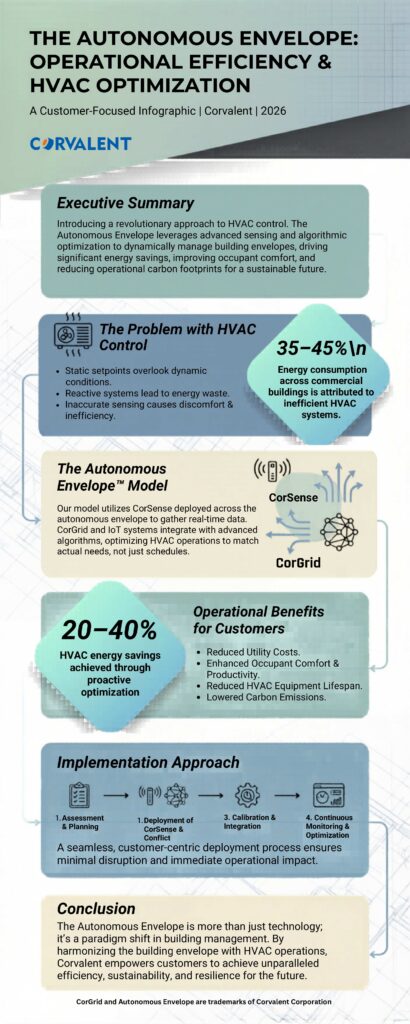
Announcing our newest Corvalent white paper, “The Autonomous Envelope: Operational Efficiency & HVAC Optimization for Commercial and Industrial Applications,” written by our IoT expert Alan R. Weiss.
Commercial and industrial buildings face increasing pressure to reduce energy costs, meet Environmental, Social and Governance (ESG) goals, and maintain 24/7 operational reliability. At the same time, many portfolios are dealing with changing occupancy patterns, deferred maintenance, staffing constraints, and the need to modernize legacy building systems without disrupting operations.
HVAC systems represent the largest energy expenditure in these facilities, often consuming 35–45% of total energy. Traditional static scheduling methods are no longer sufficient in the face of hybrid work, multi-tenant variability, and mission-critical uptime requirements. The result is a familiar set of problems: conditioning empty spaces, over-ventilating low-use areas, responding to comfort complaints after the fact, and cycling equipment in ways that shorten asset life.
Introducing the Autonomous Envelope
In this new white paper, Corvalent introduces the Autonomous Envelope; a new paradigm in building management (Smart Buildings) that leverages Corvalent’s multitude of sensors, and CorGrid, a resilient enterprise SaaS orchestration system.
The “envelope” is more than the shell of the building. It’s the real-world boundary where occupancy, indoor air quality, temperature, humidity, and operational constraints meet. Making that envelope autonomous means continuously sensing conditions, understanding how spaces are actually used, and orchestrating HVAC (and other systems) in real time—automatically, safely, and at scale.
Why static schedules fall short
Static schedules assume buildings behave the same way every day. In practice, demand shifts hour-by-hour and zone-by-zone. Conference rooms spike unexpectedly. Tenant floors vary. Lobbies and amenities see intermittent traffic. Hotels experience peaks driven by check-in patterns, events, and seasonal demand. Industrial environments add production-driven variability, safety requirements, and distinct ventilation needs.
Without accurate, granular, real-time data, building teams are forced to choose between comfort and cost. Many default to conservative settings “just in case,” which leads to energy waste and inconsistent occupant experience.
How CorGrid enables adaptive HVAC optimization
CorGrid, an industrial-grade occupancy and environmental sensing platform, enables dynamic, real-time HVAC and lighting control that adapts to actual usage patterns, delivering up to 40% energy savings, improved comfort, and extended equipment life.
The approach outlined in the white paper emphasizes an operationally practical path: instrument what matters, normalize data across environments, and orchestrate control actions that remain aligned with safety, comfort, and uptime. Key capabilities discussed include:
- Occupancy intelligence: Understand which areas are in use, how patterns change, and where schedules can be tightened without impacting comfort.
- Environmental context: Pair occupancy with temperature, humidity, and other environmental signals to prevent overconditioning and reduce hot/cold spots.
- Real-time orchestration: Translate data into coordinated actions—prioritizing stability and reliability while responding to dynamic demand.
- Portfolio scalability: Apply consistent logic across buildings and sites, while still accounting for local constraints, tenants, and operational policies.
Where this matters most
While our focus today is on commercial high-rise office buildings and hotels, the concepts are entirely applicable to industrial buildings of all types. Examples where autonomous, sensor-driven control can create meaningful impact include:
- Multi-tenant offices: Reduce after-hours conditioning and align ventilation and setpoints with actual floor-by-floor activity.
- Hotels: Improve guest comfort while minimizing energy use in intermittently occupied spaces and back-of-house areas.
- Warehouses and distribution: Target conditioning to occupied zones, support temperature-sensitive operations, and limit unnecessary runtime.
- Manufacturing: Balance process requirements with efficient ventilation and conditioning, while supporting safety and reliability.
- Critical facilities: Maintain resilience and uptime with better visibility into conditions and more responsive control strategies.
Operational benefits beyond energy savings
Energy reduction is often the headline, but the white paper also highlights operational advantages that building teams care about day-to-day:
- Fewer comfort complaints: More responsive control can reduce persistent hot/cold zones and help teams address issues proactively.
- Longer equipment life: Smarter runtime management can reduce unnecessary cycling and strain on major HVAC assets.
- Better decision-making: Measurable, real-time insights help prioritize maintenance, validate optimization projects, and support capital planning.
- ESG reporting support: More accurate usage and performance data can strengthen the quality of energy and sustainability reporting.
What you’ll learn in the white paper
The full paper goes deeper into the Autonomous Envelope approach, including the practical realities of deploying sensing and orchestration across occupied buildings. It discusses how to connect the right data signals to operational goals and how to drive optimization in a way that’s repeatable, resilient, and measurable.
To learn more about how smart sensing and adaptive control can improve building performance, read the full Corvalent white paper.